
About / CV
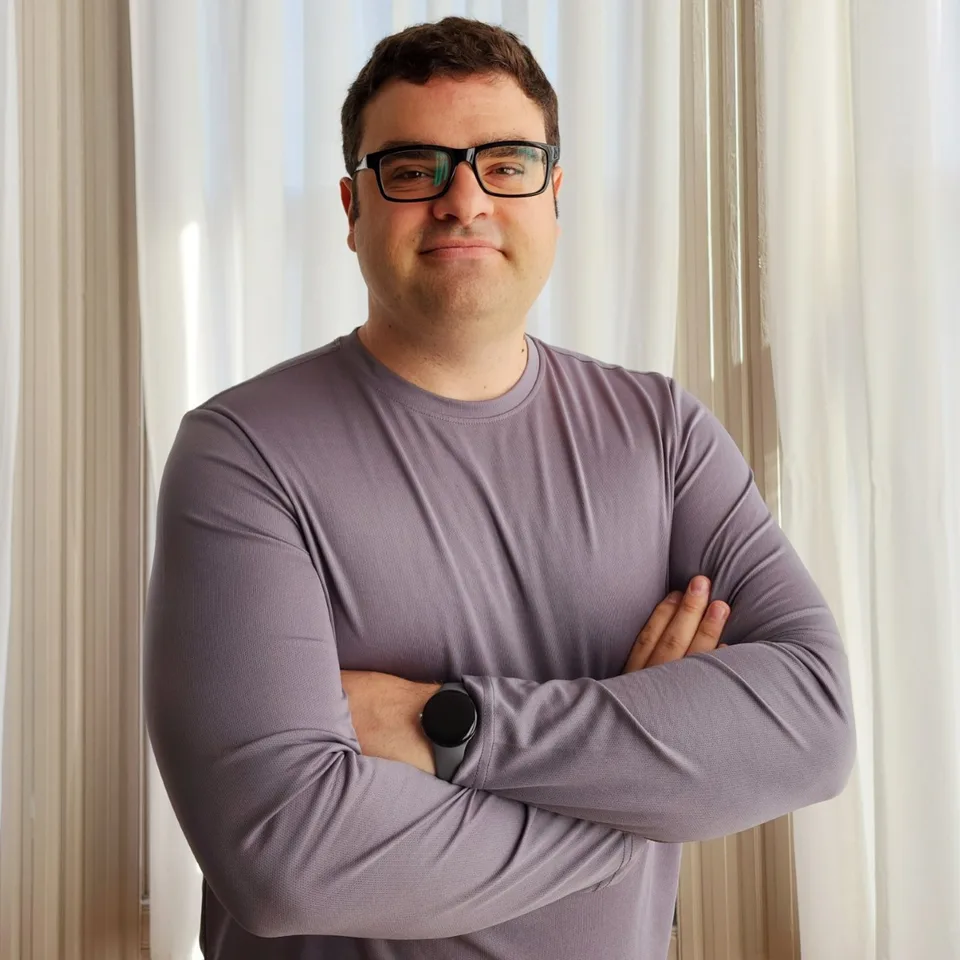 Alexander Reben
Alexander Reben is an artist and roboticist who uses invention to explore our relationships with technology and the human assumptions built into it.
Working across robotics, artificial intelligence, software, sculpture, and performance, he builds systems that invite participation and make hidden assumptions visible. Humor and absurdity run through works that explore creativity, authorship, and human responsibility.
His work has been exhibited at Ars Electronica, MAK, and the Vitra Design Museum, with solo exhibitions at bitforms Gallery, Charlie James Gallery, and GAZELL.iO. His first solo museum retrospective, AI Am I?, was presented at the Crocker Art Museum in 2023–2024.
Reben was OpenAI’s first artist in residence in 2023–2024. His other artist residencies include Facebook Open Arts in 2021, Meta in 2025, and Google in 2026. He holds an MS in Media Arts and Sciences from MIT, where he conducted research at the Media Lab, and was a visiting scholar in psychology at UC Berkeley from 2015 to 2017.
He is also a professional speaker and consultant.
Artist statement
I ask questions by building them. Most are aimed at systems that have not settled yet: a new technology, a law written for an older world, an institution that wants to know what something is for before anyone has had time to find out. Early on, the assumptions are still visible. The rules are incomplete. The people who made the technology are often as surprised by it as everyone else. That is where I like to work, before the strange becomes ordinary and disappears into the furniture.
Invention is my artistic practice. I build robots, AI systems, software, performances, and physical objects because a working thing can ask a question in a way an argument cannot. A question written down stays polite. A question built into a machine has no manners. It runs. It misreads you. It waits for your hand, your voice, or your decision. By the time you respond, you are already part of the work.
The questions change from project to project. All Prior Art asks what happens when a machine can generate ideas for inventions at a scale the patent system was never built to handle. The First Law turns an ethical thought experiment into a robot that may prick a participant’s finger. In AI Am I?, a language model imagines not just the artworks but the artists and critics around them, and I make selected pieces real. A machine-dreamed art world smuggled into the actual one. The question is where, in all of that, the art-making happened, if it indeed happened at all. Sometimes I make things that make things, machines whose whole job is to show automation's insides while it works. These works are connected by what I do to them: I build a system, push on it, and see what gives.
Most of the work begins in play. A prototype can fail without embarrassment. A silly machine can lower people’s guard. The difficult conversation begins before anyone has decided how they are supposed to respond. Absurdity works in much the same way. A ridiculous machine can make a serious contradiction visible. It may also arrive before the culture has a category for it. Many ordinary technologies would have sounded absurd a generation ago. In my studio, the line between a joke, a prototype, an invention, and an artwork is not very stable. I prefer it that way.
I do not think technology is here to save us, and I do not think it is the villain. Both stories are too easy. Machines are full of people: our labor, preferences, assumptions, shortcuts, and blind spots.
When working with generative technology, I prefer the word "symbiosis" to "collaboration". Collaboration makes a machine sound more human than it is. Still, the loop is real. I shape a system. It gives me something I did not expect. I change what I am doing in response. Authorship moves around inside that loop, even though responsibility remains human.
I take technologies apart, use and misuse them, then I put them back together so their hidden rules become easier to see. The work does not settle the argument. It leaves the contradiction running in the room.
I am an artist by process of elimination. A company, laboratory, or department usually needs a purpose, a product, or a result. I often need not to know. Art is the place I have found where an invention can remain unresolved long enough to teach me what it is. The invention is not just a tool for making the artwork. It is the form the thinking takes.
There is nothing artificial that we did not make. Every machine is, in part, a self-portrait with the flattering angles removed. I build these mirrors to see what we are extending, what we are automating, and what we are willing to trade away. I want to know whether the things we make can help us become more human rather than less.
I would rather meet the future in the workshop, while I can still take it apart and put it back together, than read about it after someone else has decided what it means.
Alexander Reben
https://areben.com
Selected CV.
Solo exhibitions
Write a convoluted exhibition title for Alexander Reben’s show in the basement of the Charlie James Gallery
Charlie James Gallery, Los Angeles, CA
AI Am I?
The Crocker Art Museum, Sacramento, CA
Delusions of a Time-Traveling Cactus
bitforms Gallery, New York, NY
I’m Not A Painter
GAZELL.iO Project Space, London, England
AI-Mazing
GAZELL.iO Project Space, London, England
Creative Work as Adversary: The AI Art of Alexander Reben
Emerson Media Art Gallery, Boston, MA
Contrasts in Action Still
stARTup Art Fair – Special Project, Los Angeles, CA
strange/r/evolution
SPRING/BREAK Art Show, New York, NY
wax chromatic
Charlie James Gallery, Los Angeles, CA
Engineering Psychology
Charlie James Gallery, Los Angeles, CA
Selected group exhibitions
EMERGENCE: From Conway to Collective Intelligence
Kate Vass Galerie, Zürich, Switzerland
Augmented Intelligence
Auction exhibition and live performance, Christie’s Rockefeller Center galleries, New York, NY
Encoded: Art With No Boundaries
VISU Contemporary with bitforms gallery, Miami Beach, FL
SMALL V01CE
Honor Fraser, Los Angeles, CA
Speak Art Into Life
TED, Vancouver, BC
Speak Art Into Life
TED Women, Atlanta, GA
Speak Art Into Life
Aspen Ideas Festival, Aspen, CO
DALL·E, Artificial Imagination
bitforms Gallery, San Francisco, CA
ULTRAMARIN
Venice, IT
Hello Robot
Vitra Design Museum, Weil am Rhein, Germany
Creative Machine
Goldsmiths University, London, UK
Immutable
Vellum LA, Los Angeles, CA
Let’s Talk About Text
Gazelli Art House, London, England
Hello Robot
Hyundai Motorstudio, Busan, Korea
Hello Robot
Hyundai Motorstudio, Beijing, China
Abstract Art in the Age of New Media
Museum of Contemporary Digital Art (MoCDA), online
The Game of Life: Emergence in Generative Art
Kate Vass Galerie, online
CURRENTS New Media Festival
Santa Fe, NM
Hello Robot
Neues Museum Biel, Biel, Switzerland
With a Little Help from My Friends: A Benefit for Bryan Chagolla
Charlie James Gallery, Los Angeles, CA
Hello Robot
V&A Museum of Design, Dundee, Scotland
Post City
Ars Electronica, Linz, Austria
Hello Robot
Museo San Telmo, San Sebastián, Spain
Hello Robot
MAAT, Lisbon, Portugal
Pas de Deux — MAX 2019: A Space Festival
Performance with Alice Sheppard, Exploratorium, San Francisco, CA
Seeing Eye Awareness
Galerija Vžigalica, Ljubljana, Slovenia
Gray Area Festival
San Francisco, CA
CODAME
San Francisco, CA
ARTOBOTS
The Midway Gallery, San Francisco, CA
Hello Robot
Gewerbemuseum, Winterthur Switzerland
Robot Art
Museum of Science and Industry, Chicago, IL
LAST Festival
Stanford University, Stanford, CA
DEMO DAY
Kunstraum, Brooklyn, NY
Post City
Ars Electronica, Linz, Austria
Hello Robot
Design Museum Ghent, Ghent, Belgium
Robots. Work. Our Future
Vienna Biennale, Vienna, Austria
Hello Robot
MAK Contemporary Art Museum, Vienna, Austria
Hierophant
Nicodim Gallery, Bucharest, Romania
The Basilisk
Nicodim Gallery, Los Angeles, CA
Hello Robot
Vitra Design Museum, Weil am Rhein, Germany
IDFA
Amsterdam, Netherlands
WIRED 2016 UK
London, England
Chicago Ideas Week
Chicago, IL
Camden Film Festival
Camden, ME
Perception & Time
Long Now Member Summit, San Francisco, CA
Seattle Art Fair
Charlie James Gallery, Seattle, WA
Nuit de la science
CERN, Geneva, Switzerland
Happy Machine
Ottawa Maker Faire, Ottawa, Canada
LAST Festival
Stanford University, Stanford, CA
SPEIF
Special Project Space, San Jose, CA
COllISION
Boston Cyberarts Gallery, Boston, MA
Robots in Residence
Aspen Ideas Festival, Aspen, CO
Sonic Gorilla
Warwick Arts Centre, Warwick, UK
TFI Interactive
Tribeca Film Festival, New York, NY
New Works
Culture Shock Project Space, VOLTA, New York, NY
Robots in Residence
1MSQFT, Miami, FL
Robots in Residence
Sheffield Doc / Fest, Sheffield, England
Robots in Residence
Nordisk Panorama, Malmo, Sweden
Robots in Residence
Storyscapes at the Tribeca Film Festival, New York, NY
COLLISION18:Present
Axiom Center for New and Experimental Media, Jamaica Plain, MA
Robots in Residence
IDFA, Amsterdam, Netherlands
ArtBots
Ghent, Belgium
You Are My Sunshine: Axiom At Bumpkin Island Closing
Axiom Center for New and Experimental Media, Jamaica Plain, MA
Solar absurdities
Bumpkin Island Art Encampment. Bumpkin Island, Boston, MA
IDENTITY ELEMENT: WORKS FROM THE NEW AXIOM GROUP
Axiom Center for New and Experimental Media, Jamaica Plain, MA
Defy Gravity
MIT Media Lab, Cambridge, MA
Human Nature
ARS Electronica Festival, ARS Electronica, Linz, Austria
School of The Streets
MIT Weisner Gallery, Cambridge, MA
Whitney Biennial — James Chimpton
Technical contribution to Neighborhood Public Radio’s presentation with Steve Lambert and Jeff Crouse, Whitney Museum of American Art, New York, NY
Planet in Peril: Artists Sow Solutions
EYEBEAM, New York, NY
URECA
SAC Gallery, Stony Brook, NY
LICA Exhibition
SAC Gallery, Stony Brook, NY
Collections
The Crocker Art Museum Permanent Collection
JPMorgan Chase Art Collection
Facebook / Meta Art Collection
MIT Museum
Speaking / appearances
TECHNĒ 3.0: Art in the Age of Robots
Featured speaker, mHUB, Chicago, IL
The Factory of the Imagination: Creative Agency vs. Agentic AI
Conversation with Kc Ifeanyi, Fast Company Grill at SXSW, Austin, TX
AI-Powered Art: The Influence of Robots on Creative Expression
Panel, NVIDIA GTC, San Jose, CA
Speaking art into life with AI
Experience Summit, Web Summit Qatar, Doha, Qatar
Press Conference on the Future of AI
With Chandra Rangan, Web Summit Qatar, Doha, Qatar
AI: From Research to Practice
Panel, Christie’s Art+Tech Summit, New York, NY
AI and the Artist
Berkeley Art, Finance, and Law Symposium, SFMOMA, San Francisco, CA
Can AI and art co-exist?
Interview with Jared Bowen, The Culture Show, GBH
Robots, AI, and Making Courageous Futures
Fireside chat with Tim Brown, IDEO × San Francisco Design Week, San Francisco, CA
AI AM I?
University of California Berkeley, Berkeley, CA
AI AM I?
University of Nevada Reno, Reno, NV
Backstory: Alexander Reben and Jesse Damiani
Crocker Art Museum, Sacramento, CA
The Creative Future of Generative AI
MIT, Cambridge MA
A.I.’s Rendezvous with Art: The Future of Creative Expression
Aspen Ideas Festival, Aspen, CO
Generative AI as a Creativity Tool?
UC Berkeley, Berkeley, CA
AI AM I?
CSU Fresno, Fresno, CA
AI Am I?
Goldsmiths University, London, UK
AI-Mazing — artist talk
Gazelli Art House
Curators Talk: Jason Bailey and Alex Reben
Conversation with Kate Vass, Kate Vass Galerie
Artistic Process and Generative Art
Panel with Helena Sarin and David Young, moderated by Jason Bailey, SuperRare Generative & AI Art Week
Online Art for the Age of Plague
Stanford LASER, online
AI Art
CCA University, San Francisco, CA
Artist talk
Human–machine collaboration, Artivive Art Space, Vienna, Austria
Creative Work as Adversary — artist talk
Art Technology New England, Emerson Urban Arts Media Gallery, Boston, MA
The Future of Creative AI
TTI Vanguard, San Francisco, CA
Human-Machine Collaboration and Artificial Intelligence
Startup Art Fair, San Francisco, CA
Artificial Intelligence and Philosophy
CIIS University, San Francisco, CA
Creative AI and IP
Harvard University, Cambridge, MA
AI and Art
UC Merced, Merced, CA
Pas de Deux: Machine Human Interface and the Creative Space
With Sasha Samochina and Alice Sheppard, MAX Chats, Z Space, San Francisco, CA
Human-Computer Collaboration
Leonardo LASER, University of San Francisco, San Francisco, CA
Artist as Technologist
TTI Vanguard, San Francisco, CA
5 Dollars Can Save Planet Earth
TEDx San Francisco, CA
A.I. Fortunes
Dorkbot, San Francisco, CA
Art and Science
The Exploratorium, San Francisco, CA
If an AI makes it, is art still Art?
CODAME, San Francisco, CA
Artist’s lecture
Museum of Science and Industry, Chicago, IL
AI Creativity in Art, Neuroscience, and the Law
SXSW, Austin, TX
Stories of Song, Art & Tech
me Conference, Austin, TX
Using Art and Design to Investigate Humanity
Berkeley Institute of Design, UC Berkeley, Berkeley, CA
Design Field Notes
Jacobs Institute, UC Berkeley, Berkeley, CA
Living in a Robot?
MAK Museum, Vienna, Austria
Future Humanity
Ars Electronica, Linz, Austria
LASER Lecture
Stanford University, Menlo Park, CA
Ethics and Artificial Intelligence
CIIS University, San Francisco, CA
Judah vs. The Machines
TechCrunch, Digital Web Series
Emotional Arcade Live
IDFA, Amsterdam, Netherlands
Thinking Digital
Gateshead, England
From cute droids to robots that stab you, it’s time to get personal with machines
WIRED UK, London, England
The Implications of Artificial Intelligence
Chicago Ideas Week, Chicago, IL
Internet of Things and Memory
Camden Film Festival, Camden, ME
LASER Art Lecture
UC Berkeley, Berkeley, CA
California College of the Arts
San Francisco, CA
Philosophy and The Future of Technology
Stanford University, Menlo Park, CA
Art and Social Robotics
California College of the Arts, San Francisco, CA
How Robots Mess With Our Minds
MIT Club of Southwest Florida, Naples, FL
Homo Digitalis
LAST Festival, Stanford University, Stanford, CA
The BlabDroid Robots
Global Technology Symposium, San Mateo, CA
The Rise of the Social Robot
SXSW, Austin, TX
Human-Machine Empathy
UC Berkeley Philosophy Department, Berkeley, CA
Film making Robots and Human-Machine Relationships
Dorkbot, San Francisco, CA
Robotic Art
California College of the Arts, San Francisco, CA
BlabDroids
Engadget Expand, New York, NY
Drones, Phones, and Robotic Friends-Where Is Emergent Technology Taking Us?
Aspen Ideas Festival, Aspen, CO
Big Ideas Opening Session
Aspen Ideas Festival, Aspen, CO
The Needy Robot and Our Relationship with Emotional Machines
TTI Vanguard, Boston, MA
Social Robotics – Interaction and Design
Robo Forum, Moscow, Russia
Igniters: BlabDroid
NBC and SyFy, Las Vegas, NV
Will Robots Take Over The World?
HuffPost Live
BlabDroids — Self-Learning Social Cloud Robots
TEDx, Boston, MA
BlabDroids — Self-Learning Social Cloud Robots
Google Solve for X, Boston, MA
Control Your Legal Landscape
Robo Business Conference, San Jose, CA
Transmedia and Robot Filmmaking, Doc/Tech
Points North at Camden Film Festival, Camden, MA
BlabDroids Around the World
Nordisk Panorama, Malmo, Sweden
Transmedia and Technology
Transmedia Meet Up, Malmo, Sweden
BlabDroids, Art as Research
Ignite at FOO, Sebastopol, CA
Robots in Residence
Sheffield Doc / Fest, Sheffield, England
Robots as Journalists
Columbia Journalism School, New York, NY
Emotionally Evocative Robots
Thinking Digital, Gateshead, England
Interactive Technology in Media
Media Future, Dun Laoghaire, Ireland
Storyscapes
Tribeca Film Festival, New York, NY
Needy Robotics and Our Intimate Interrelationship with Technology
Berkeley Center for New Media, UC Berkeley, Berkeley, CA
Robots in Residence, Screening and Theory
DocLab at IDFA, Amsterdam, Netherlands
Boxie, The Story Gathering Robot
Ignite Boston, Boston, MA
Fellowships / appointments / memberships
Artist in Residence
Artist in Residence
Meta
Artist in Residence
OpenAI
Open Arts Artist in Residence
Affiliate
MetaLab, Harvard University
Online Artist in Residence
GAZELL.iO
Visiting Scholar
UC Berkeley Psychology
WIRED Innovation Fellow
Stochastic Labs Residency
DocLab Fellow
MIT Comparative Media Studies
MIT Art Scholar
Center for Future Storytelling Fellow
MIT
Tau Beta Pi Engineering Honor Society
Golden Key International Honor Society
Teaching / mentorship
Lead, Tangible Imagination residency subgroup
Liveness + Agency summer residency, Stochastic Labs, Berkeley, CA
Mentor
Sundance New Frontiers Story LAB, Sundance, CO
Instructor, Social and Creative Robotics
UC Berkeley, Berkeley, CA
Stochastic Labs
Berkeley, CA.
Instructor, Interactive Technology Design
MIT, Cambridge, MA
Instructor, Promoting Art Through Design (PATD)
MIT, Cambridge, MA
Undergraduate Research Opportunities Program (UROP) Advisor
MIT, Cambridge, MA
Women in Science and Engineering (WISE) Program
SUNY Stony Brook, NY
F.I.R.S.T. Robotics Competition
Patchogue, NY
Education
MS, Media Arts & Sciences
Massachusetts Institute of Technology, Media Lab
BS, Applied Mathematics
Stony Brook University, cum laude